

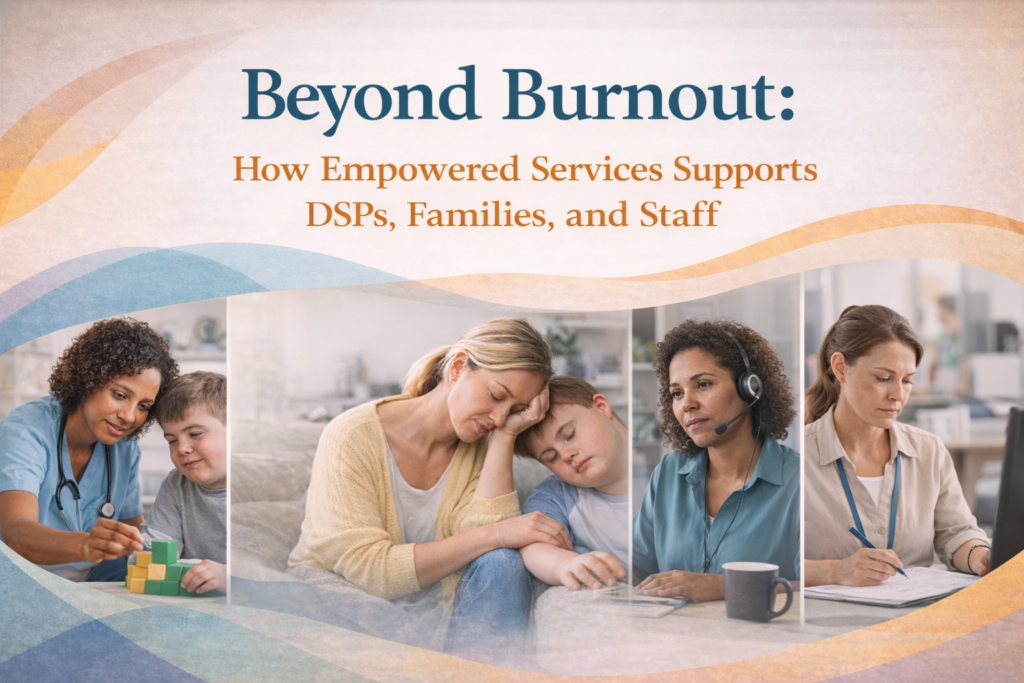
Beyond Burnout.
How Empowered Services supports DSPs, families, and staff.
Burnout is not inevitable, but risk rises when sustained demands repeatedly exceed available support, recovery time, control, and resources. When caregivers are supported, the people they support benefit too. Here are the signs, the pressures unique to IDD care, and the three pillars guiding how we show up.
There is a quiet crisis unfolding in the world of caregiving. It does not make headlines. It accumulates — day after day, shift after shift — until the people we depend on to care for the most vulnerable among us find themselves running on empty.
Sustained caregiving demands can produce exhaustion, detachment, reduced effectiveness, and significant strain. For DSPs, care coordinators, and other employees, chronic workplace stress can develop into occupational burnout. Family and unpaid caregivers can experience severe caregiver strain, role overload, compassion fatigue, and similar burnout-like exhaustion.
At Empowered Services, we believe that caring for the caregiver is not optional. It is the foundation upon which quality support is built.
The numbers tell a sobering story.
The IDD caregiving workforce faces some of the highest turnover and burnout rates in human services. The demands are not just physical — they are deeply emotional, requiring sustained compassion, patience, and adaptability across unpredictable circumstances.
National DSP turnover has remained near this level across the sector. — Relias/ANCOR, 2025 DSP Survey Report
Of IDD family caregivers report feeling very or extremely stressed — up from 48% in 2017. — ICI / The Arc, 2023
Of family caregivers say they are providing more supports due to the direct support workforce shortage. — ICI / The Arc, 2023
Behind every statistic is a real person — a DSP who stayed late for the third time this week, a parent who has not had a full night’s sleep in months, a care coordinator managing caseloads that keep growing.
In Oregon, the combination of workforce shortages and complex care needs makes stability and prevention especially important. The OHSU DSP Workforce Report (2024) highlights instability and elevated turnover across Oregon providers — conditions that increase strain on DSPs, families, and agency teams alike.
Burnout rarely arrives all at once.
It often builds gradually, which can make it easy to normalize or miss. If these signs persist, worsen, interfere with daily functioning, or extend beyond work, treat them as a signal to seek support — not as a personal failure. Burnout can overlap with depression, anxiety, trauma responses, sleep disorders, and medical conditions, so avoid assuming every symptom is “just burnout.”
- ›Chronic fatigue that does not improve with rest — a persistent sense of being physically and emotionally drained.
- ›Emotional detachment or growing cynicism toward work that once felt meaningful.
- ›Increased irritability, anxiety, or helplessness that extends beyond the workplace.
- ›Physical symptoms — headaches, disrupted sleep, appetite changes, or frequent illness.
- ›Withdrawal from colleagues, family, and the social connections that provide support.
- ›A diminishing sense of accomplishment — feeling that no matter how hard you work, it is never enough.
“The people who hold others together deserve to be held together too. That is not a benefit we offer — it is the baseline of how we operate.”— Empowered Services Leadership Team
A distinct set of pressures.
The Long Horizon
Unlike acute medical caregiving, IDD support is often lifelong. There is no discharge date, no recovery milestone. This marathon demands a sustainable pace — but the system rarely provides one.
Emotional Depth
DSPs and families form deep bonds with the individuals they support. When someone you care about is in distress, the toll is not clinical — it is personal. Compassion fatigue here carries a weight standard wellness programs often miss.
Systemic Pressure
Oregon’s IDD workforce faces chronic staffing shortages, complex regulations, and reimbursement structures that stretch providers thin. The OHSU report documented elevated turnover and workforce instability among Oregon providers. Individual caregivers absorb the stress of a system under pressure.
Invisible Labor
The patience, the de-escalation, the quiet presence in a hard moment — invisible to everyone except the person being supported. Naming those invisible wins is itself protective: recognition reduces cynicism and strengthens the resolve to stay.
When caregivers thrive, the people they support thrive too.
Wellness is not a program we run on the side. It is embedded in how we operate, lead, and show up — driven by operational excellence, a healthy culture, and six core values: Integrity, Empathy, Synergy, Community, Advocacy, and Legacy.
Our commitment extends across three interconnected pillars — with the individuals we support at the center of everything and support for sustainable caregiving woven into every layer.

Families We Serve
Caregiving does not stop when our team clocks out. Family members carry their own burdens around the clock — often with fewer resources and no shift change coming to relieve them. Their wellbeing is inseparable from the wellbeing of the individuals we support.
- ✓Curating our monthly Empowered IDD Resources — sensory-friendly outings, adaptive recreation, community events, and respite across Oregon.
- ✓Open communication so families feel heard, informed, and supported — as valued partners in care, not just recipients of services.
- ✓Connecting families with training through FACT Oregon, CODSN, and OCDD for knowledge and community.
- ✓Listening for signs of family caregiver fatigue and responding with compassion, resources, and referrals.
- ✓Investing in workforce stability — nearly 70% of family caregivers say the DSP shortage has directly affected their loved one’s services.
Our Providers — DSPs & ECP Caregivers
Providers and DSPs are the heart of field-level support. Whether they came to us through traditional hiring or through our Empowered Choice Program — where friends and family become paid, professional caregivers — they show up in the moments that matter most. They deserve an organization that shows up for them in return.
Refer a new DSP and earn up to $500 when they successfully begin and remain active in services.
$250 — First Milestone
The referred DSP is matched with a customer and completes their first 3 months with at least 20 paid hours each month.
$250 — Second Milestone
The referred DSP completes the next 3 months with at least 20 paid hours each month.
To qualify: The candidate must enter your full name in the caregiver profile form’s “Referred by” field. An application or hiring decision alone does not qualify for a referral payment. Open the caregiver profile form →
Terms and eligibility apply.
- ✓Schedule and workload reviews intended to support sustainable work and reduce reliance on chronic overtime.
- ✓Ongoing training and development that builds confidence, not just compliance.
- ✓Clear ways to reach leadership and raise support needs without judgment.
- ✓Recognition programs that celebrate our providers daily, not just during DSP Recognition Week.
- ✓Opportunities for peer connection with colleagues who understand the work.
Admin Staff & Customer Care Team
Behind every smooth interaction are the people who hold the operational center together — schedulers, billing specialists, compliance coordinators, office managers, and customer care professionals. They may not be in the field, but they absorb the urgency and emotional undercurrent of every decision. When a DSP calls out, this team feels it. When a family is frustrated, they hear it first.
- ✓Cross-training and team redundancy so no single person becomes a bottleneck under pressure.
- ✓Clear escalation pathways that empower team members to seek help without feeling they’re falling short.
- ✓Sustainable workload expectations that account for emotional labor, not just technical tasks.
- ✓Including all team members in wellness conversations — administrative burnout is real and reaches the field.
- ✓Growth pathways that honor this team as the operational backbone, not a back office.
Evidence-informed practices to build resilience.
Whether you’re a family partner, a DSP or ECP caregiver, or a member of our admin and Customer Care Team.
Name it to tame it
Burnout thrives in silence. Acknowledging that you’re struggling — to yourself, a trusted friend, or a supervisor — reduces its power. You are not weak for feeling exhausted. You are human.
Debrief after hard moments
After a meltdown, a hospitalization, or a safety intervention, take time to process. Carrying unprocessed events in silence is one of the fastest roads to compassion fatigue.
Protect your non-negotiables
Identify one or two daily practices that sustain you — a morning walk, time with family, a quiet coffee — and guard them fiercely. Small rituals create anchors in an unpredictable role.
Set boundaries without guilt
Saying no to an extra shift is not abandonment — it’s sustainability. The people you support need you healthy over the long haul, not heroic for a week and gone the next.
Separate advocacy from identity
For family caregivers especially, it’s easy to lose yourself in the role. You are a whole person with your own needs and dreams. Protecting that isn’t selfish — it lets you show up with presence, not resentment.
Stay connected
Isolation is burnout’s closest companion. Lean into peer relationships and community. The Arc, FACT Oregon, and the Autism Society of Oregon offer spaces built for people who understand.
Seek professional support
Therapy, counseling, and employee assistance programs exist for a reason. Using them is a sign of strength. Look for providers who understand the dynamics of disability caregiving.
Celebrate the small wins
Progress is often incremental and invisible. A moment of connection, a skill mastered, a laugh on a hard day — these are the entire point. Feel the weight of what you accomplished, not just what remains.
You don’t have to wait until you’re in crisis.
Here is how to get support at Empowered Services.
Caregiver strain and occupational burnout are not inevitable, but they become more likely when systems repeatedly ask too much of people while investing too little in support, recovery, and wellbeing. Changing that equation requires intentional, sustained commitment at every level.
We don’t claim to have all the answers — but we are firmly committed to being part of the solution. Every decision we make is tested against a single question:
“Does this protect and empower the people who give their lives to caring for others?”
If the answer is no, we change course. If the answer is yes, we lean in harder.
To every family partner, every provider and DSP, every ECP caregiver, every admin and Customer Care professional reading this: we see you. And at Empowered Services, you will always have a partner who believes that caring for the caregiver is not just good policy — it is the right thing to do.
Team Wellness — how we live this every month
Support for sustainable caregiving is not just a policy here — it is reinforced through monthly wellness practices. Every DSP and ECP provider is invited to share one privacy-safe self-care activity and is entered into a wellness gift drawing. See the culture, the four wellness pillars, and past winners.
Explore Team Wellness →If you or someone you know is in crisis
If you are experiencing thoughts of self-harm or feel unsafe, call or text the 988 Suicide & Crisis Lifeline at 988, or use the chat at 988lifeline.org. If there is immediate physical danger or a medical emergency, call 911 or go to the nearest emergency department.
For mental-health or substance-use treatment referrals and information, call the SAMHSA National Helpline at 1-800-662-4357. The service is free, confidential, available 24/7, and offered in English and Spanish.
This article is educational and is not a substitute for professional medical or mental health care.
Become part of the family.
Two paths in. The same care behind both.
Start with steady support.
If you or a loved one needs support, our team is ready to walk with you. Begin with a quick intake — and learn how the Empowered Choice Program puts your family in the driver’s seat.
See all IDD servicesBuild a career that protects you back.
We hire DSPs across Oregon — and the wellness culture you’ve just read about is part of the deal. Submit your interest, or view current open roles.
Join our team