
Beyond Burnout
How Empowered Services Supports DSPs, Families, and Staff
Empowered Services · March 2026
Excerpt: Caregiver burnout isn’t inevitable—it’s a predictable outcome when demands outpace support. At Empowered Services, we believe that when caregivers thrive, the people they support thrive too. Here are the signs of burnout, the unique pressures in IDD caregiving, and the three pillars guiding how we support the families we serve, our providers and DSPs, and the admin staff and Customer Care Team across Oregon.
🔗 Share this article: empowered-services.org/beyond-burnout
There is a quiet crisis unfolding in the world of caregiving. It does not make headlines. It does not announce itself with a single dramatic event. Instead, it accumulates—day after day, shift after shift—until the people we depend on to care for the most vulnerable among us find themselves running on empty.
Caregiver burnout is the state of physical, emotional, and mental exhaustion that develops when caregivers give more than they can sustain. For Direct Support Professionals (DSPs), family members, and care coordinators supporting individuals with intellectual and developmental disabilities (IDD), burnout is not a distant risk—it is an occupational reality.
At Empowered Services, we believe that caring for the caregiver is not optional. It is the foundation upon which quality support is built.
The Scope of the Problem
The numbers tell a sobering story. National research consistently reveals that the IDD caregiving workforce faces some of the highest turnover and burnout rates in the human services sector. The demands are not just physical—they are deeply emotional, requiring sustained compassion, patience, and adaptability across unpredictable circumstances.
Often near or above 40–50% — National DSP turnover rate, varying by agency size and region (Relias/ANCOR, 2025 DSP Survey Report)
54% — Of IDD family caregivers report feeling very or extremely stressed—up from 48% in 2017 (ICI / The Arc, 2023 Family Caregiver Survey)
80%+ — Of family caregivers say they are providing more supports due to the direct support workforce shortage (ICI / The Arc, 2023)
Behind every statistic is a real person—a DSP who stayed late for the third time this week, a parent who has not had a full night’s sleep in months, a care coordinator managing caseloads that keep growing.
In Oregon, the combination of workforce shortages and complex care needs makes stability and prevention efforts especially important. The OHSU DSP Workforce Report (2024) highlights workforce instability and elevated turnover across Oregon providers—conditions that increase strain on DSPs, families, and agency teams.
When these individuals reach their breaking point, the consequences ripple outward: service quality declines, staff shortages deepen, and the people we support feel the instability most acutely.
Recognizing the Signs
Burnout rarely arrives all at once. It builds gradually, which is precisely what makes it so dangerous. By the time someone recognizes they are burned out, they have often been struggling for weeks or months.
Common indicators include:
- Chronic fatigue that does not improve with rest—a persistent sense of being physically and emotionally drained
- Emotional detachment or growing cynicism toward work that once felt meaningful and fulfilling
- Increased irritability, anxiety, or feelings of helplessness that extend beyond the workplace
- Physical symptoms such as headaches, disrupted sleep, appetite changes, or frequent illness
- Withdrawal from colleagues, family, and social connections—the very relationships that provide support
- A diminishing sense of accomplishment—feeling that no matter how hard you work, it is never enough
If you have been noticing these signs for two or more weeks, treat it as a signal—not a personal failure.
For DSPs and family caregivers alike, there is an additional layer of complexity: the guilt that comes with acknowledging your own needs. Caregivers are often conditioned to put others first. Admitting that you are struggling can feel like admitting that you are failing the people who depend on you. Nothing could be further from the truth.
“The people who hold others together deserve to be held together too. That is not a benefit we offer—it is the baseline of how we operate.” — Empowered Services Leadership Team
What Makes IDD Caregiving Unique
While burnout affects caregivers across every field, those who support individuals with intellectual and developmental disabilities face a distinct set of pressures that deserve specific recognition:
The Long Horizon. Unlike acute medical caregiving, IDD support is often lifelong. There is no discharge date, no recovery milestone that signals the end of the journey. This marathon nature demands a sustainable pace—but the system rarely provides one.
Emotional Depth. DSPs and families form deep bonds with the individuals they support. When someone you care about is in distress, the emotional toll is not clinical—it is personal. Compassion fatigue in IDD services carries a weight that standard workplace wellness programs often fail to address.
Systemic Pressure. Oregon’s IDD workforce faces chronic staffing shortages, complex regulatory requirements, and reimbursement structures that can leave providers stretched thin. The OHSU DSP Workforce Report documented workforce instability and high turnover—with ratios at larger agencies exceeding 58%. Individual caregivers absorb the stress of a system under pressure, often without adequate institutional support.
Invisible Labor. Much of what caregivers do—the patience, the de-escalation, the quiet presence during a difficult moment—is invisible to everyone except the person being supported. This lack of recognition compounds over time. That is why naming invisible wins is itself a protective practice—recognition reduces cynicism and strengthens the resolve to stay.
The Empowered Services Commitment
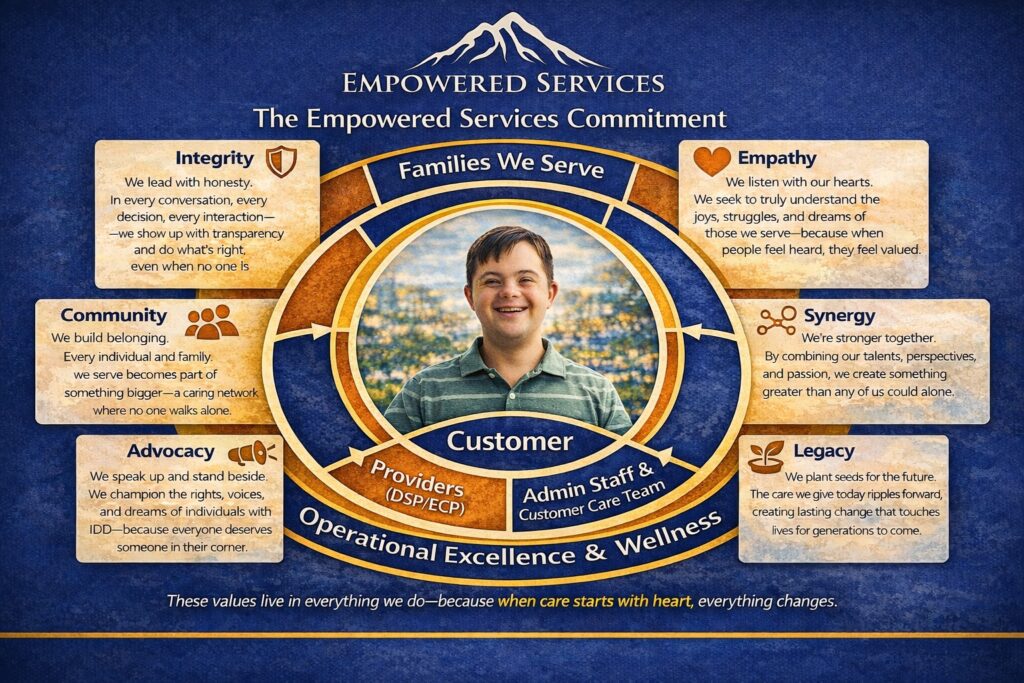
At Empowered Services, we built our organization on a simple conviction: when caregivers thrive, the people they support thrive too. Wellness is not a program we run on the side. It is embedded in how we operate, lead, and show up for our community every single day—driven by a commitment to operational excellence, a healthy organizational culture, and six core values that guide every decision we make: Integrity, Empathy, Synergy, Community, Advocacy, and Legacy.
Our commitment extends across three interconnected pillars—with the individuals we support at the center of everything, and burnout prevention woven into every layer.
Pillar 1: Families We Serve
Caregiving does not stop when our team clocks out. Family members carry their own caregiving burdens around the clock—often with fewer resources, less visibility, and no shift change coming to relieve them. They are partners in care, resource navigators, and round-the-clock caregivers all at once. Their wellbeing is inseparable from the wellbeing of the individuals we support.
What we commit to:
- Curating our monthly Empowered IDD Resources page to connect families with sensory-friendly outings, adaptive recreation, community events, and respite opportunities across Oregon
- Maintaining open lines of communication so families feel heard, informed, and supported—not just as recipients of services, but as valued partners in care
- Connecting families with training opportunities through organizations like FACT Oregon, CODSN, and OCDD so they have access to knowledge and community
- Listening for the signs of family caregiver fatigue during our interactions and responding with compassion, resources, and referrals—not just service updates
- Investing in our own workforce stability, because nearly 70% of family caregivers say the DSP workforce crisis has directly affected their loved one’s services
What you will see: Resource navigation support. Proactive communication—not just when something goes wrong. A team that treats families as partners, not paperwork.
Pillar 2: Our Providers — DSPs & ECP Caregivers
Providers and Direct Support Professionals are the heart of field-level support. Whether they came to us through traditional hiring or through our Empowered Choice Program (ECP)—where friends and family become paid, professional caregivers—they show up in the moments that matter most: the difficult mornings, the breakthroughs, the quiet acts of dignity that no one else sees. They deserve an organization that shows up for them in return.
We have also revised our referral program to reflect how much we value the people already doing this work. Existing DSPs and ECP caregivers who identify and refer a matching provider for an IDD individual we support are eligible for a $1,000 referral bonus, paid after the referred provider completes 90 days of at least 30 hours per week. No one knows what great care looks like better than the people already providing it.
What we commit to:
- Maintaining manageable caseloads and scheduling practices that prioritize work-life balance over chronic overtime
- Providing ongoing training and professional development that builds confidence, not just compliance
- Practicing open-door leadership that listens without judgment—because the first step to preventing burnout is creating a culture where people feel safe saying they need support
- Running recognition programs that celebrate the extraordinary work our providers and DSPs do, not just during DSP Recognition Week, but as a daily practice of gratitude
- Building peer support networks that connect caregivers with colleagues who understand the unique joys and challenges of the work
We monitor overtime trends, conduct regular check-ins, and take staffing challenges seriously—not as abstract operational problems, but as direct contributors to the wellbeing of the people we employ and the people we serve.
What you will see: Proactive schedule reviews when hours climb. Post-incident debrief options within 24–72 hours. Protected, paid training time. A culture where saying “I need a break” is treated as professionalism, not weakness.
Pillar 3: Admin Staff & Customer Care Team
Behind every smooth interaction and every carefully coordinated schedule are the people who hold the operational center together—schedulers, billing specialists, compliance coordinators, office managers, and customer care professionals. They may not be in the field, but they absorb the urgency, complexity, and emotional undercurrent of every operational decision. They are the bridge between family partners, providers, and the individuals we support.
When a DSP calls out, this team feels it. When a family is frustrated, they hear it first. When systems strain, they hold the pieces together before anyone else knows something was breaking.
What we commit to:
- Building cross-training and team redundancy so that no single person becomes a bottleneck—or a single point of failure under pressure
- Creating clear escalation pathways that empower team members to seek help without feeling like they are falling short
- Setting sustainable workload expectations that account for the emotional labor of supporting a caregiving organization, not just the technical tasks on a to-do list
- Including all team members in wellness conversations and team-building, because administrative and operational burnout is real and it directly impacts the quality of support that reaches the field
- Offering professional development and growth pathways that honor the critical role this team plays in our mission—not as a back office, but as the operational backbone
- Fostering a culture of mutual respect where every role—from the front desk to the front line—is valued as essential to making a difference every day
What you will see: No-retaliation support escalation. Defined check-in intervals. Workload conversations that happen before the breaking point, not after. Recognition that connects your spreadsheet, your phone call, your schedule fix to a real person’s better day.
Practical Strategies for Every Caregiver
Whether you are a family partner, a DSP or ECP caregiver, or a member of our admin and Customer Care Team, these evidence-informed practices can help you build resilience and protect your wellbeing over the long term:
Name it to tame it. Burnout thrives in silence. Simply acknowledging that you are struggling—to yourself, to a trusted friend, or to a supervisor—reduces its power. You are not weak for feeling exhausted. You are human.
Debrief after difficult moments. IDD caregiving involves behavioral crises, medical emergencies, and emotionally complex situations that most wellness programs never address. After a tough incident—a meltdown, a hospitalization, a safety intervention—take time to process what happened. Talk it through with a colleague, a supervisor, or a counselor. Carrying unprocessed events in silence is one of the fastest roads to compassion fatigue.
Protect your non-negotiables. Identify one or two daily practices that sustain you—a morning walk, time with your family, a quiet cup of coffee before the day begins—and guard them fiercely. Small rituals create anchors of stability in a role that is anything but predictable.
Set boundaries without guilt. Saying no to an extra shift or stepping back from a commitment is not abandonment. It is sustainability. The people you support need you healthy over the long haul, not heroic for one week and gone the next. If you are a provider, we can help you identify boundaries that still protect the person you support.
Separate advocacy from identity. For family caregivers especially, it is easy to lose yourself entirely in the role. You are not just a caregiver—you are a whole person with your own needs, dreams, and relationships. Protecting your identity outside of caregiving is not selfish. It is what allows you to keep showing up with presence rather than resentment.
Stay connected. Isolation is burnout’s closest companion. Lean into peer relationships, attend community events, join a support group. Organizations like The Arc, FACT Oregon, and the Autism Society of Oregon offer spaces specifically designed for people who understand what you are going through. You do not have to carry this alone.
Seek professional support. Therapy, counseling, and employee assistance programs exist for a reason. Using them is a sign of strength and self-awareness, not defeat. Look for providers who understand the specific dynamics of disability caregiving—it makes a real difference.
Celebrate the small wins. In IDD caregiving, progress is often incremental and invisible to the outside world. A moment of genuine connection, a skill mastered after months of practice, a laugh shared on a hard day—these are not small things. They are the entire point. Let yourself feel the weight of what you accomplished, not just what remains undone.
If You Are Burning Out: What to Do at Empowered Services
You do not have to wait until you are in crisis. Here is how to get support:
1. Tell us early. Reach out to your coordinator, your supervisor, or call (503) 855-3581. There is no penalty for raising your hand—only respect.
2. Quick check-in (same week). We will schedule a conversation within the week to understand what you are experiencing and what kind of support would help most.
3. Adjustments that fit. Based on that conversation, we will explore concrete changes—scheduling modifications, caseload rebalancing, peer support connections, training accommodations, or referrals to outside resources.
4. Follow-up (so it does not fade). We set a follow-up date to check back in. Burnout recovery is not a single conversation—it is a sustained commitment, and we will stay in it with you.
The Path Forward
Caregiver burnout is not inevitable. It is the predictable consequence of a system that has historically asked too much of its people while investing too little in their wellbeing. Changing that equation requires intentional, sustained commitment at every level—from individual self-care practices to organizational culture to state and federal policy.
At Empowered Services, we do not claim to have all the answers. But we are firmly committed to being part of the solution. We advocate for systemic changes that improve working conditions, compensation, and support infrastructure for everyone in the IDD ecosystem.
Every decision we make—from how we schedule shifts to how we design our resource pages to how we communicate with families—is tested against a single question:
“Does this protect and empower the people who give their lives to caring for others?”
If the answer is no, we change course. If the answer is yes, we lean in harder.
To every family partner, every provider and DSP, every ECP caregiver, every admin and Customer Care professional reading this: we see you. And at Empowered Services, you will always have a partner who believes that caring for the caregiver is not just good policy—it is the right thing to do.
If you or someone you know is in crisis
If you are experiencing thoughts of self-harm or feel unsafe, please contact the 988 Suicide & Crisis Lifeline by calling or texting 988, or chat at 988lifeline.org. You are not alone, and help is available right now.
For caregiver-specific support, you can also reach the SAMHSA National Helpline at 1-800-662-4357 (free, confidential, 24/7).
This article is educational and is not a substitute for professional medical or mental health care.
Empowered Services · Making a Difference Every Day
empowered-services.org · (503) 855-3581 · info@empowered-services.org
🔗 Share this article: empowered-services.org/beyond-burnout
Sources
AARP & National Alliance for Caregiving. Caregiving in the U.S. (2020). Accessed February 2026.
Relias & ANCOR. 2025 DSP Survey Report. Accessed February 2026.
Institute on Community Integration & The Arc. Squeezed: Caregivers Report Less Help, More Stress (2023 Family Caregiver Survey). Accessed February 2026.
OHSU Institute on Development & Disability. Stability of the Direct Support Professional Workforce in Oregon (2024). Accessed February 2026.
NCI-IDD. State of the Workforce Survey (2023). Accessed February 2026.
National Alliance for Direct Support Professionals. nadsp.org. Accessed February 2026.
Family Caregiver Alliance. Caregiver Statistics: Demographics. Accessed February 2026.